The short answer
A heat pump survey is the visit where an installer measures your home, works out how much heat it loses, checks your radiators, pipes and electrics, and finds positions for the outdoor unit and hot water cylinder. For a typical house it takes two to three hours. Afterwards you should get a written design and a fixed price that you can check line by line. The survey decides almost everything about how well the system will work, so it is worth being home, asking questions and expecting detail.
Before the visit
You can make the survey quicker and the quote more accurate by having a few things ready:
- Your EPC. You need a valid Energy Performance Certificate for the Boiler Upgrade Scheme in England and Wales. Find it on the government register on gov.uk.
- Recent energy bills, ideally a full year of gas or oil use. This helps sense-check the heat loss figure.
- Any building work history, such as cavity wall insulation, extensions or new windows.
- Clear access to the loft, airing cupboard, consumer unit (fuse box), boiler and the outside walls.
- Your priorities, such as where you would rather not see the outdoor unit, or how many showers you run at once.
What the installer does, room by room
| Area | What they check | Why it matters |
|---|---|---|
| Every heated room | Dimensions, windows, doors, external walls | Feeds the heat loss calculation |
| Walls, loft and floors | Construction and insulation depth | Sets the rate of heat loss through each surface |
| Radiators | Type and size of each one | Decides which radiators need upsizing |
| Pipework | Pipe sizes and layout | Heat pumps need good water flow |
| Electrics | Consumer unit, supply capacity | The heat pump needs its own circuit |
| Hot water | Space for a cylinder, household size | Sizes and positions the cylinder |
| Outside | Positions for the outdoor unit, distance to neighbours | Noise, planning and pipe routes |
The heat loss calculation is the heart of the survey. Our guide on what size heat pump you need explains how it works. The radiator check is covered in radiators for heat pumps.
Outside: noise, planning and access
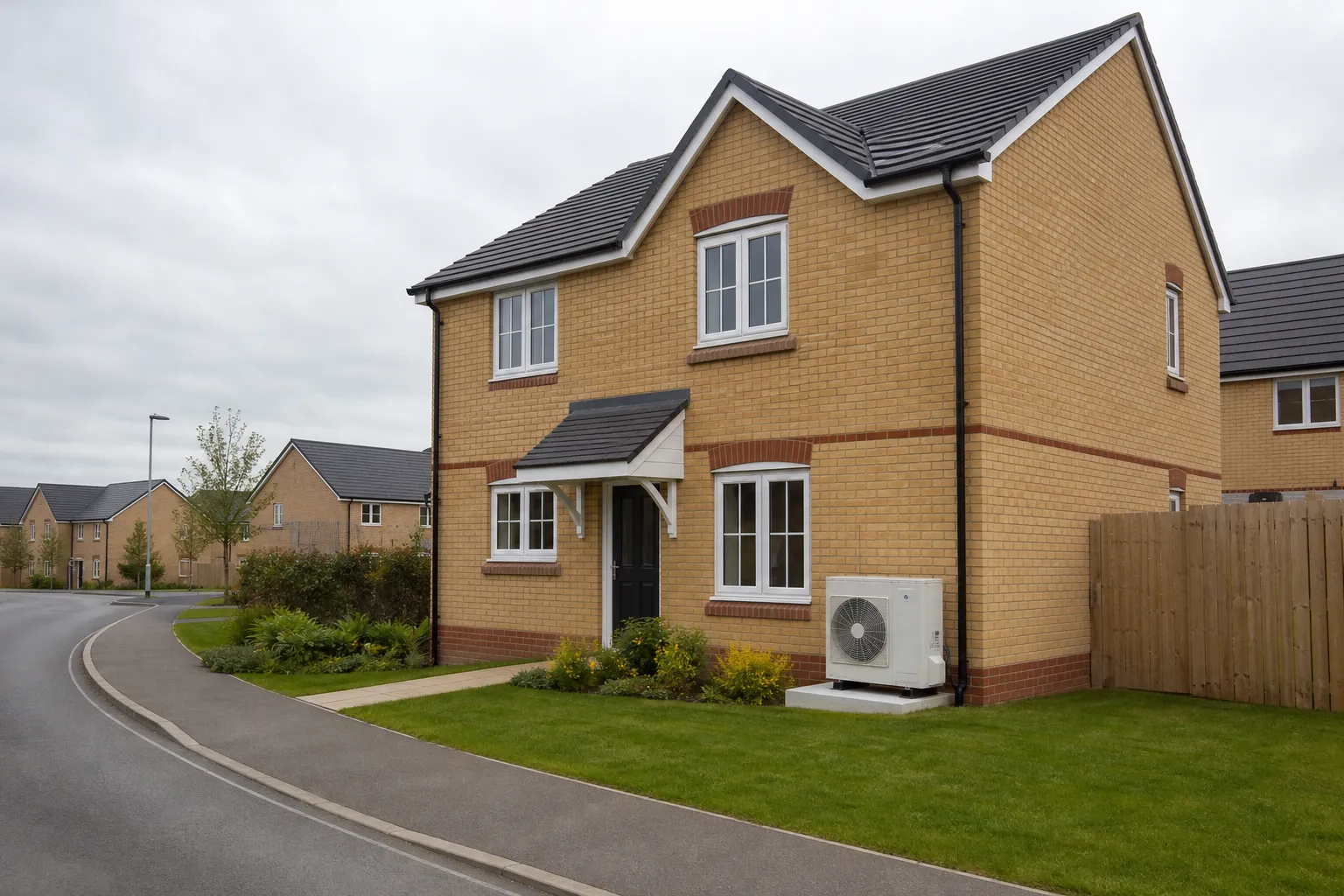
The installer will look for a spot with good airflow, a firm base, a short pipe run to the house and enough distance from the neighbours’ windows to meet the noise standard. They should tell you whether the property has permitted development rights or whether planning permission or listed building consent is needed. See our noise and planning guide for the general rules.
They will also check the route for pipes and cables into the house, and whether a drain is nearby for the small amount of water the outdoor unit produces when it defrosts.
Questions worth asking on the day
- What flow temperature are you designing for, and why?
- Which radiators will you change, and to what size?
- Where will the cylinder go, and how big will it be?
- Will the outdoor unit sit on the ground or on a wall bracket?
- Is my electricity supply big enough, or does the network operator need to be told?
- Who applies for the Boiler Upgrade Scheme grant, and when?
- How long will the installation take, and how long will I be without heating?
Write the answers down, or ask the installer to put them in the quote. A verbal promise is hard to hold anyone to later.
What you should receive afterwards
A good quote from an MCS-certified installer should include:
- The heat loss figure for the whole house, in kW.
- The heat pump make, model and output at your design temperature.
- A room by room radiator schedule.
- The cylinder make and size.
- The outdoor unit position and any planning notes.
- An estimate of running costs or the expected efficiency over a year.
- A fixed price, with the grant shown as a deduction where it applies.
A typical air source heat pump costs £11,000 to £14,500 before any grant, and £3,500 to £7,000 after the £7,500 Boiler Upgrade Scheme grant in England and Wales (typical, checked October 2026). In England and Wales, the MCS-certified installer applies for the grant and takes it off your bill. In Scotland, you apply to Home Energy Scotland before work starts. Our Boiler Upgrade Scheme guide has the details.
Warning signs
Be cautious if an installer:
- Quotes a heat pump size without measuring the rooms.
- Will not share the heat loss calculation.
- Says every radiator can stay without checking them.
- Pushes you to sign on the day to secure the price.
- Cannot show an MCS certification number. You can check it on mcscertified.com.
Comparing surveys
If you get more than one quote, compare the heat loss figures. They should be in the same ballpark. If one installer says 6kW and another says 12kW for the same house, ask both to explain. The difference often comes down to assumptions about insulation and draughts, and one of them is likely to be wrong.
City Boiler is not an installer. We connect you with independent MCS-certified installers who carry out a full survey and give you a fixed price in writing.
Common questions
How long does a heat pump survey take?
Allow two to three hours for a typical house. Larger or older homes with more rooms, extensions or unusual construction can take longer. A visit of twenty minutes is too short to measure a house properly.
Do I have to pay for a heat pump survey?
Some installers survey free and include the cost in the installation price. Others charge a fee, sometimes refunded if you go ahead. Ask before the visit so there are no surprises.
What should I get after the survey?
A written quote with the heat pump model and output, the heat loss figure, a room by room radiator schedule, the cylinder size, the outdoor unit position and a fixed price. If you are in England or Wales, it should show the Boiler Upgrade Scheme grant deducted.
Can a survey be done remotely?
Some installers start with a remote or video assessment to give a rough price. That can be useful, but a proper heat loss calculation and design normally need someone in the house measuring rooms and checking pipes.