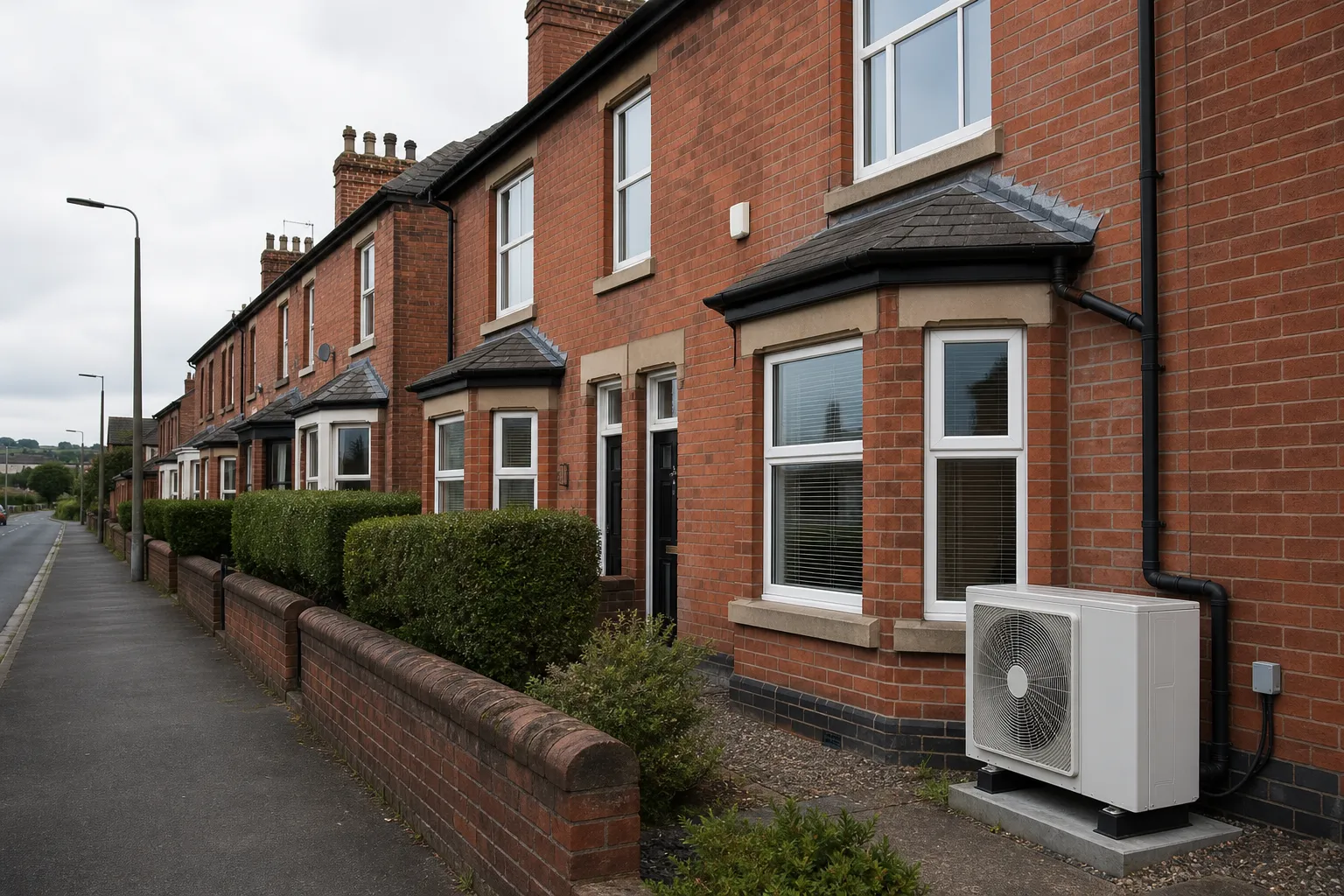
The short answer
In England, most houses can fit an air source heat pump without applying for planning permission, because it counts as permitted development. That means it is allowed automatically as long as it meets a set of conditions, including a noise limit at the neighbours’ nearest window and rules on the unit’s size and position. Listed buildings almost always need consent, and conservation areas, World Heritage Sites and flats can bring extra limits. Scotland, Wales and Northern Ireland have their own rules. These rules have changed recently and will change again, so check with your installer or your council before you commit to a position. The official starting point is gov.uk.
How loud is a heat pump?
An air source heat pump has a fan that draws air across a heat exchanger and a compressor that does the work. Both make some noise. Typical sounds are:
- A low fan hum while it runs.
- More noise in very cold weather, when it works harder.
- A brief whoosh during defrost, when it clears ice from the coil on cold, damp days.
Inside the house you usually hear nothing. Outside, a well-placed modern unit is quieter than people expect, but it is not silent, and close neighbours in a tight yard may notice it.
What makes a heat pump louder than it needs to be
| Cause | What to do instead |
|---|---|
| Wall bracket fixed to a bedroom wall | Ground mounting on anti-vibration feet |
| Tucked into a corner or narrow gap | A position with open air around it, as sound reflects off nearby walls |
| Oversized or undersized unit | Size from a proper heat loss calculation |
| Pointed straight at a neighbour’s window | Angle or move it so the noisiest side faces away |
| Poorly fitted pipework touching walls | Isolated pipe clips and flexible connections |
Most noise problems come from position and installation, not the brand.
England: permitted development in general terms
For a house in England, an air source heat pump is usually permitted development if:
- It meets the noise standard. The installer runs a standard noise assessment, based on the unit’s sound rating and the distance to the nearest neighbour’s habitable room window or door. It must come in under the limit.
- It meets size and number limits. There are limits on the size of the outdoor unit and how many units a property can have.
- It meets position rules. There are rules on how the unit relates to boundaries, roofs and the front of the house, and it should be sited to keep visual impact low.
- It is removed when no longer needed.
The government relaxed some of these conditions in recent years, so older advice you read online may be out of date. Your MCS-certified installer should confirm the current conditions for your property.
If your house is a listed building, you will almost certainly need listed building consent, whatever the position. Speak to your council’s conservation officer before you book a survey.
The exceptions
Expect extra checks or a planning application if:
- The building is listed. Permitted development does not cover works that affect a listed building’s character.
- You are in a conservation area or World Heritage Site. There are often limits on units facing a road or visible from the street.
- You live in a flat. Permitted development rights for heat pumps are mainly for houses. Flats are more likely to need permission and freeholder consent. Our guide to heat pumps in terraced houses and flats covers this.
- The council has made an Article 4 direction, which removes some permitted development rights in an area.
- The unit cannot meet the noise standard in any available position.
Scotland, Wales and Northern Ireland
Planning is devolved, so each nation sets its own rules:
- Scotland has its own permitted development rules for heat pumps, with different conditions on position and boundaries.
- Wales sets its own conditions, which do not always match England’s.
- Northern Ireland has separate planning legislation again.
In all three, the principle is similar: many houses can fit a heat pump without a full application if conditions are met, with tighter rules for listed buildings and protected areas. The details differ, so check your local council’s planning pages or ask your installer. In Scotland, Home Energy Scotland can also point you to current guidance.
Ground source heat pumps
A ground source system has no outdoor fan unit, so noise outside is rarely an issue. The planning questions are about the groundworks, boreholes or trenches, and these are usually permitted development for houses too. See our ground source heat pump guide for what that work involves.
What to ask your installer
- Have you run the noise assessment for this position, and what was the result?
- Does this property have permitted development rights, or will it need an application?
- Is the property listed or in a conservation area, and have you checked?
- Will the unit sit on the ground on anti-vibration feet, or on a wall bracket?
A good installer handles the noise assessment as part of the survey and tells you plainly if a planning application is needed. If one is, allow extra weeks before installation. Our survey guide covers where this fits in.
City Boiler is not an installer. We connect you with independent MCS-certified installers who check noise and planning for your house before they quote.
Common questions
Do I need planning permission for an air source heat pump?
For most houses in England, no. An air source heat pump is usually permitted development, provided it meets conditions on noise, size and position. Listed buildings, some conservation area positions and flats are common exceptions, and rules change, so check with your installer or council.
How loud is a heat pump?
A modern air source heat pump makes a low fan hum and some compressor noise, louder in cold weather when it works harder. Standing a few metres away, most people compare it to a fridge or a quiet conversation. Placement matters more than the model.
Can my neighbour complain about my heat pump?
They can, and the council can investigate noise complaints. Choosing a sensible position, anti-vibration mounts and a correctly sized unit makes problems unlikely. The installer's noise assessment is designed to keep the unit within the permitted limits.
Are the rules the same in Scotland, Wales and Northern Ireland?
No. Each nation sets its own planning rules for heat pumps, with different conditions on size, position and distance to boundaries. Check the current rules for your nation before you fix the position.